

Presence: P.O.V's traumatic mirror
Notes on P.O.V., the filmic gaze, & fantasies of the nuclear family. All of society is the young woman’s voyeur.

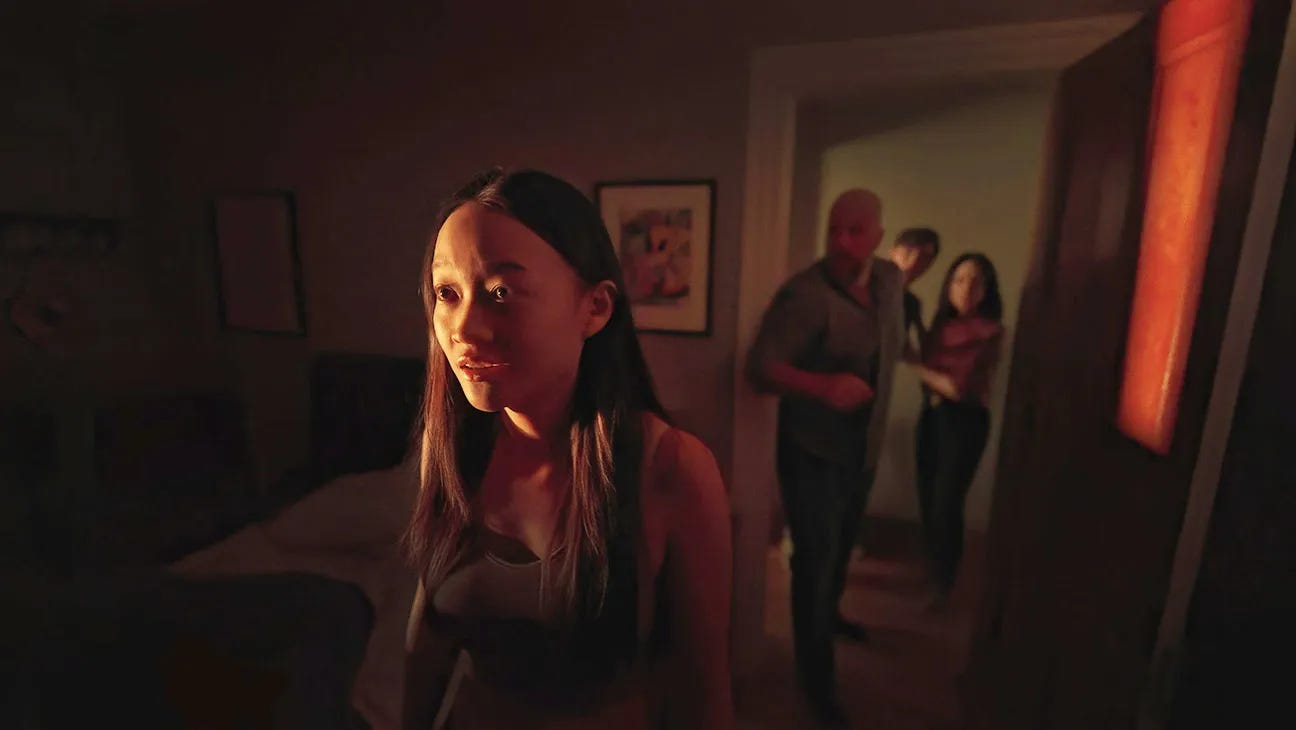
The following notes on Steven Soderbergh’s Presence (2024) outline how I have engaged with the film, particularly its use of p.o.v. and its effect on audiences. Precisely because the entirety of the film uses p.o.v. as a narrative device, I think Presence generates many different interpretations and emotional responses depending on who’s watching. That said, my read on this film feels more personal than others I have written, because p.o.v. forces the viewer to construct a lot of the unrepresented content of the film by way of the viewer’s unconscious identifications. Because each response is personal to the viewer, it also means writing this is cause of some embarrassment for me, probably why it took so long to make it public.
I’ll share some thoughts about the effective use of p.o.v in this film and explore some themes related to the deterioration of the family. Like other horror films that represent a haunting, presence exposes death as a cohering force in the nuclear family.
I’ve collected my notes here and resisted a more linear review, in part because I think this film invites sprawling engagement despite being filmed in such a straight forward way. That may be due in part to the latent content of the film, which touches upon darker aspects of the nuclear family’s taboos and disavowed excesses. These are hard to write about and are also what make Presence such a gut punching and exciting movie.
Preliminary Notes on P.O.V.
Presence is shot in the p.o.v of a ghost who follows the lives of a nuclear family that just moved into a new home. It presents us with a semblance of the American Dream—a mixed race family affords a home in the most coveted school district in the area, thus ensuring its successful reproduction. As film audience, we do not know who the ghost is or what it wants—our eyes are hijacked by the wandering camera as it follows the family’s whereabouts in their home according to the ghost’s mysterious aims.
Given the inherent reflexive quality (or maybe reflective quality) of p.o.v, it relies on the activation of audience’s fantasies by way of presenting us with an absence in the visual field that arouses desire. P.o.v is a convention that invites the viewer to not only imagine what it’s like to see through the eyes of the absent person, but also to fill in the gaps by imagining the absent person’s thoughts and motivations in the midst of action that surrounds them.
If I allowed myself to suspend disbelief and pretended to embody the ghost’s gaze as it followed characters throughout the room, it stirred up discomfort, hesitancy, desire—and exposed the inherently voyeuristic gaze of the film lens.
Allowing myself to play with the film’s p.o.v device, I asked myself: why am I here? Why am I looking at this family so intently? Why didn’t I choose to act sooner to save Chloe (little sister played by Callina Liang) from a sadistic killer? These questions stirred up fantasies about who the ghost could be and sustained desire throughout the film.
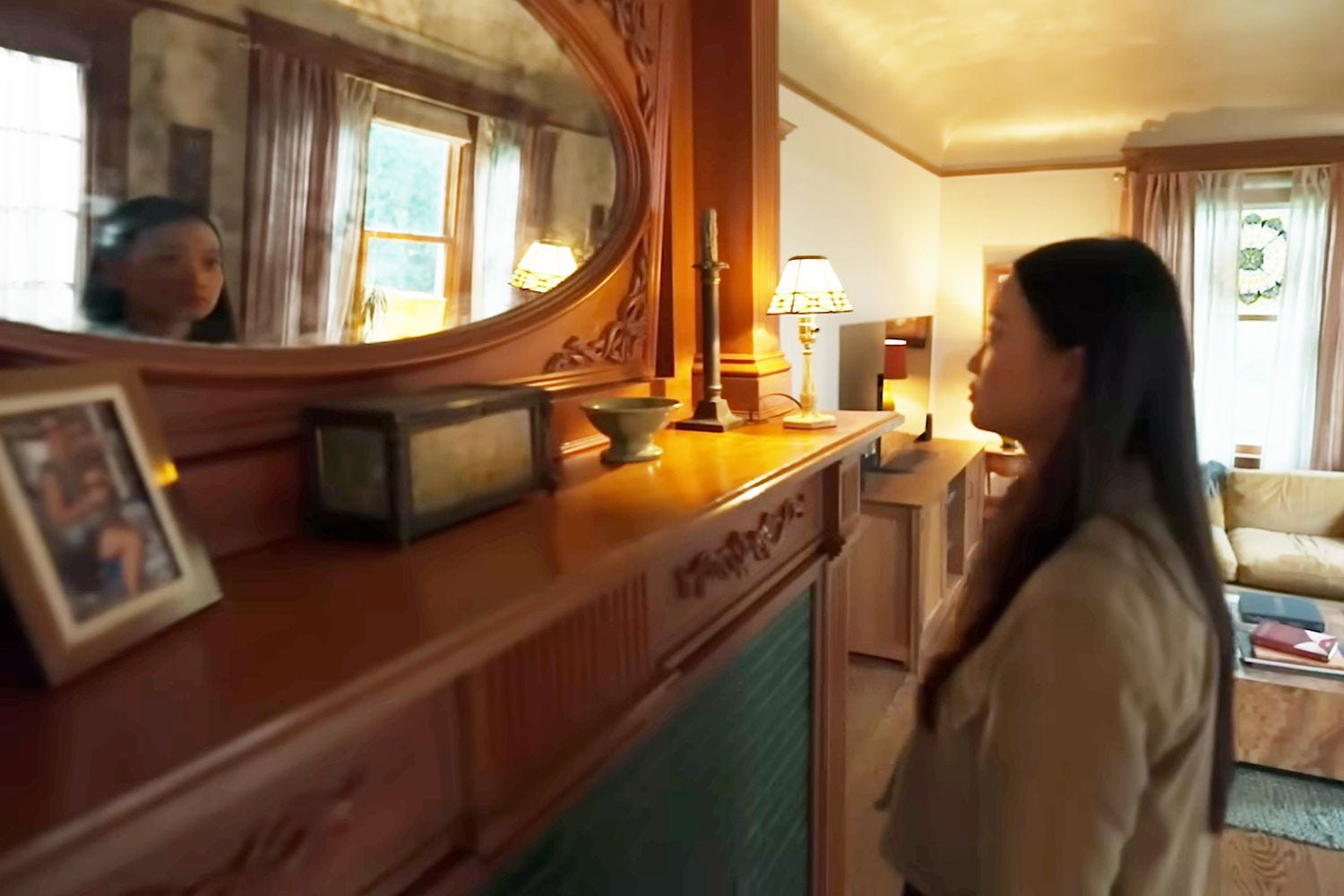
The mirror that exposes the truth of the p.o.v. character’s identity at the end of the film likewise reveals the motive force in the p.o.v.’s gaze. The purpose of the ghost was to preserve the virtue of the family, represented by the objective of keeping the daughter’s sexual integrity intact and enabling the brother to redeem himself. This is ideologically sustained by depicting young women’s sexuality as vulnerable and by arousing audience’s protective tendency through anxieties caused by a sexual and deadly intruder.
Like the necro-sexual intruder Ryan (West Mullholand), who deceives and drugs Chloe, the audience is also positioned as an intruder and voyeur—undead and with questionable desires and intentions.
Metz’ Film as Mirror
Since the camera stands in for the gaze of the ghost, it assumes an agency that precludes it from the illusion of neutrality or objectivity. The film camera is never neutral, but in p.o.v., we are stripped from the illusion that it is. In this way, I was split off from myself, while at the same time, returning to my emotional experiences as they were projected onto the character whose gaze I was glued to.
It was of course my own emotional experience that I identified as the character’s experience. In this way, as early psychoanalytic film theorist Christian Metz posits— “the film is like a mirror” (Metz p. 45). “In other words, the spectator identifies with himself, with himself as a pure act of perception…” (Metz p. 49).
This is the process of identification, through which we believe we view parts of ourselves in others, often without even knowing that’s what we’re doing. In this way, we make assumptions about the thoughts of others, which are actually our own thoughts projected into the minds of other people. The process of identification in film is itself an illusion in as far as we cannot know the thoughts of fictional characters as they are depicted (fictional characters lack the capacity for thought). We think for them with our own thoughts.
The miracle of film’s influence is that it stages a fantasy while generating and playing with desire in its viewers, and the result is a polyvalent relation in which viewers are watching themselves watching themselves in a filmic mirror.
The prevalence of the antique mirror in Presence orients us to this reflection. This mirror both hides and exposes the film’s conclusion.
The Other’s P.O.V.
What is necessarily absent in p.o.v. is a mirror to the character whose gaze we embody. The mirror is internal to the audience. This tiny internal mirror means that p.o.v tells us more about us than it does about the movies we watch. In p.o.v. we Inhabit what is not visible in the Other.
Presence plays well with this trope, at times teasing us with a possible identity we can wear and testing multiple perspectives as we watch the film. For instance, Chloe thinks the presence she feels is her dead best friend.
At times I wondered if the gaze I was embodying was a feminine or masculine one, young or old, kind or perverse. How I imagined it transformed the way that I felt about each scene. At times, I felt protective, other times like an invasive creep.
In one scene, a spiritual medium tells the family that the presence in their home may not know who they are or what they are meant to do. It is a nod to our position as audience who are also trying to figure out whose gaze we are inhabiting.
Some Thoughts on Todd McGowan’s: The Real Gaze: Film Theory After Lacan.
In The Real Gaze, McGowan examines how cinema attempts to render the gaze visible through filmic devices that arouse desire or captivate us with fantasies. He argues that cinema can serve as a powerful means to render our own ideological fantasies visible to us. Likewise, film can further our stupor by staging powerful fantasies that reinforce ideology. Film also acquaints us with how we enjoy, even if our enjoyment contradicts how we would rather view ourselves.
“By rendering the excess of the gaze visible through fantasy, cinema makes us aware of the hidden enjoyment that silently informs our social reality…confronts spectators with the source of their own enjoyment and deprives them of the illusion of a neutral social reality. This gives the cinema of fantasy its political, ethical, and existential power.” (p.25)
More on the gaze and the act of seeing:
“But the gaze is an object that does not fit, and object that cannot be reduced to the level of other objects. It protrudes as an excessive piece of reality that we cannot find anywhere within the reality. The gaze is a disturbance in the normal functioning of reality because it indicates that our social reality is not simply there as a neutral field. Instead, reality exists as something seen, something that we ourselves constitute through the act of seeing; in consequence, our seeing itself is included within our reality as the gaze.” (p. 25)
The Gaze Changes After the Twist
On second viewing of this film, knowing that the p.o.v belongs to the teen girl’s deceased brother, I felt a sense of familiarity, protectiveness, and grief in the p.o.v. itself. It was as if the camera was trying to find its way back into belonging with the family, to understand its role in it. Knowing the identity of the ghost also adds another affective dimension—anticipation of tragedy and grief permeates the film, where it had not been as salient before. The film felt more tender, less creepy.
The topics of grief, death, control, and loss of control are often broached in conversation by characters and serve as surprisingly elegant textual backdrops that infuses each interaction with dark foreboding.
We learn that Death and Eros exert secret control over the family.
The sister’s dead best friend was present in name only and in the consolation it offered Chloe to believe that her friend was the presence that stalked her family. At times, I imagined myself in the p.o.v of her best friend and felt warmth, grief, even despair related to my own femininity, girl-friendships, and sexual-terror, which is so pervasive in teen girls.
Once I realized that the p.o.v. belonged to the brother, the film inspired a different set of questions related to masculinity, control, and incestuous fantasy.
Nuclear Family
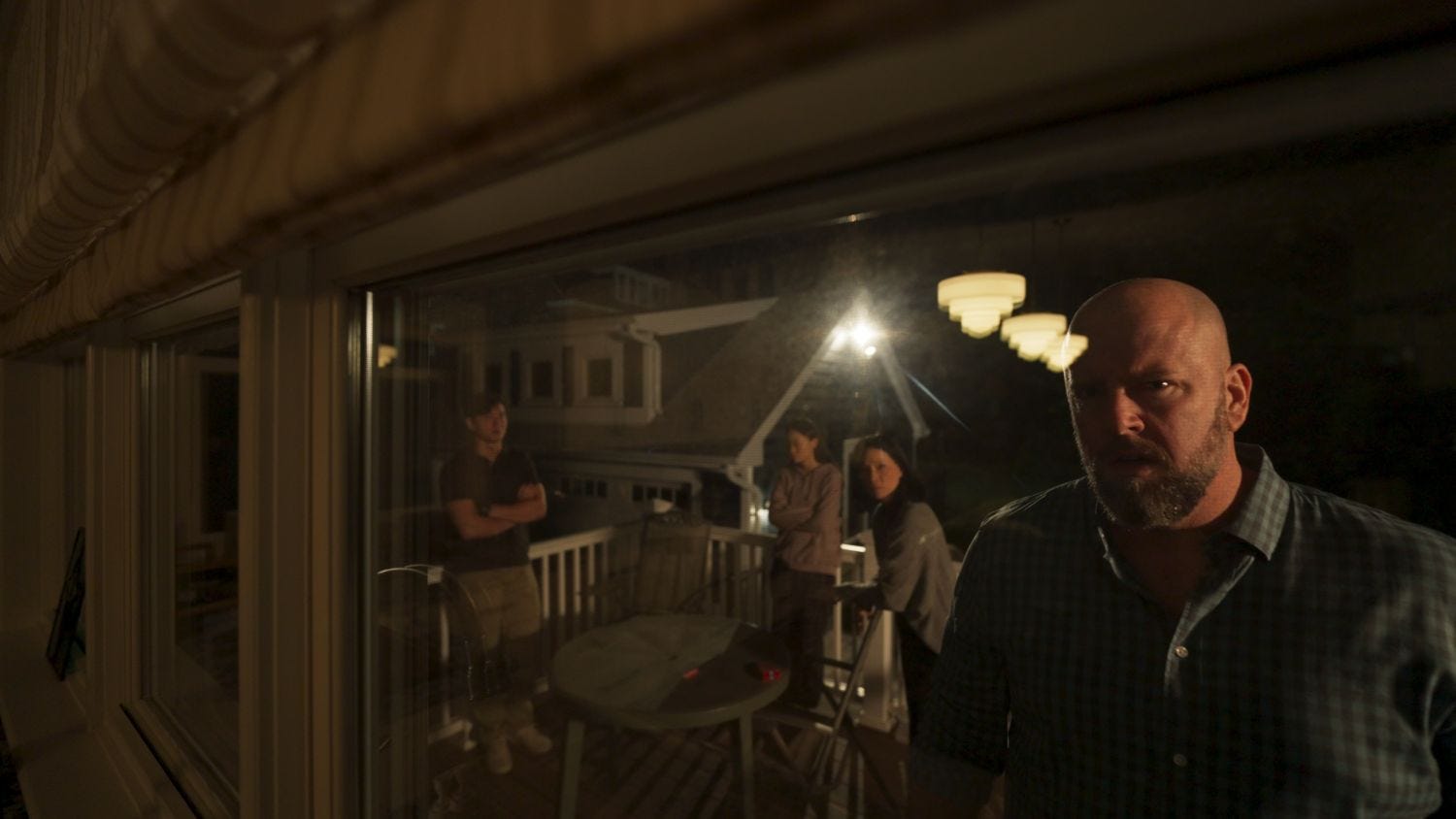
The film situates us outside of the nuclear family, as one who is outside looking in. It exposes the family’s secrets and reveals the dysfunction that coheres them.
When the father walks outside of their home to speak with a lawyer about fraud and divorce, we witness through the window the nuclear family’s crumbling facade.
The invisible p.o.v. voyeur exposes the dysfunctional inner workings of a family: the hidden sexual violence, perverse parental grooming, financial fraud, and relational conflicts that are hidden by a veneer of polite relations and empty symbolic roles.
The use of p.o.v. as a character who is outside of the family heightens the distinction between the family performance of conviviality and each individual’s ambivalence toward the unit. We do not identify with the family but are forced to identify with the camera, somehow immersed while at the same time outside, excluded—it is its own agent.
We thus inhabit our seats as audience more clearly. Audience which is both outside and inevitably inside. Or an audience that watches a film from the inside-out.
Impotent Father and Vulnerable Young Woman
Presence’s father Chris (Chris Sullivan) is depicted as having no influence on the mother’s neglectful attitude toward her daughter. Although Chris appears concerned and tries to speak up in defense of Chloe, he lacks authority and hence cannot restore the family to harmonious relations. He tells his wife: “Have you ever noticed how your advice always corresponds exactly with us not having to do anything, at all?”
The filmic argument seems to be that the father’s impotence leads to the splitting of the family. The mother, Rebecca (Lucy Liu) detaches from the father and narcissistically attaches to her son’s academic and sports success as a reflection of her value. His son Tyler (Eddy Maday) sadistically cyber bullies a young woman and delights in the sexual humiliation which his mother seems to condone. The son is unable to hear his father’s exhortation: “There is an excellent man inside of you, Tyler. I would love to see him soon.” Here are some speculations on the plot that follow:
If we follow the film’s logic, the brother’s sacrifice is called for as a necessary means to preserve the daughter's virtue, to end his own role in toxic masculinity in the home, and to restore the integrity of the family by uniting them in grief.
We as audience may feel concerned about Chloe’s sexual virtuousness and violation. The sex scenes between teens, although consensual, felt uncomfortable, made unnerving by the sustained gaze of the ghost watching from Chloe’s bedroom closet. It is the voyeuristic quality that condemns the audience and flirts with incest taboo.
There is perhaps a moral indignation toward preserving young girl’s virginity and condemning a masculinity that uses young women’s bodies to serve a fantasy of power and control.
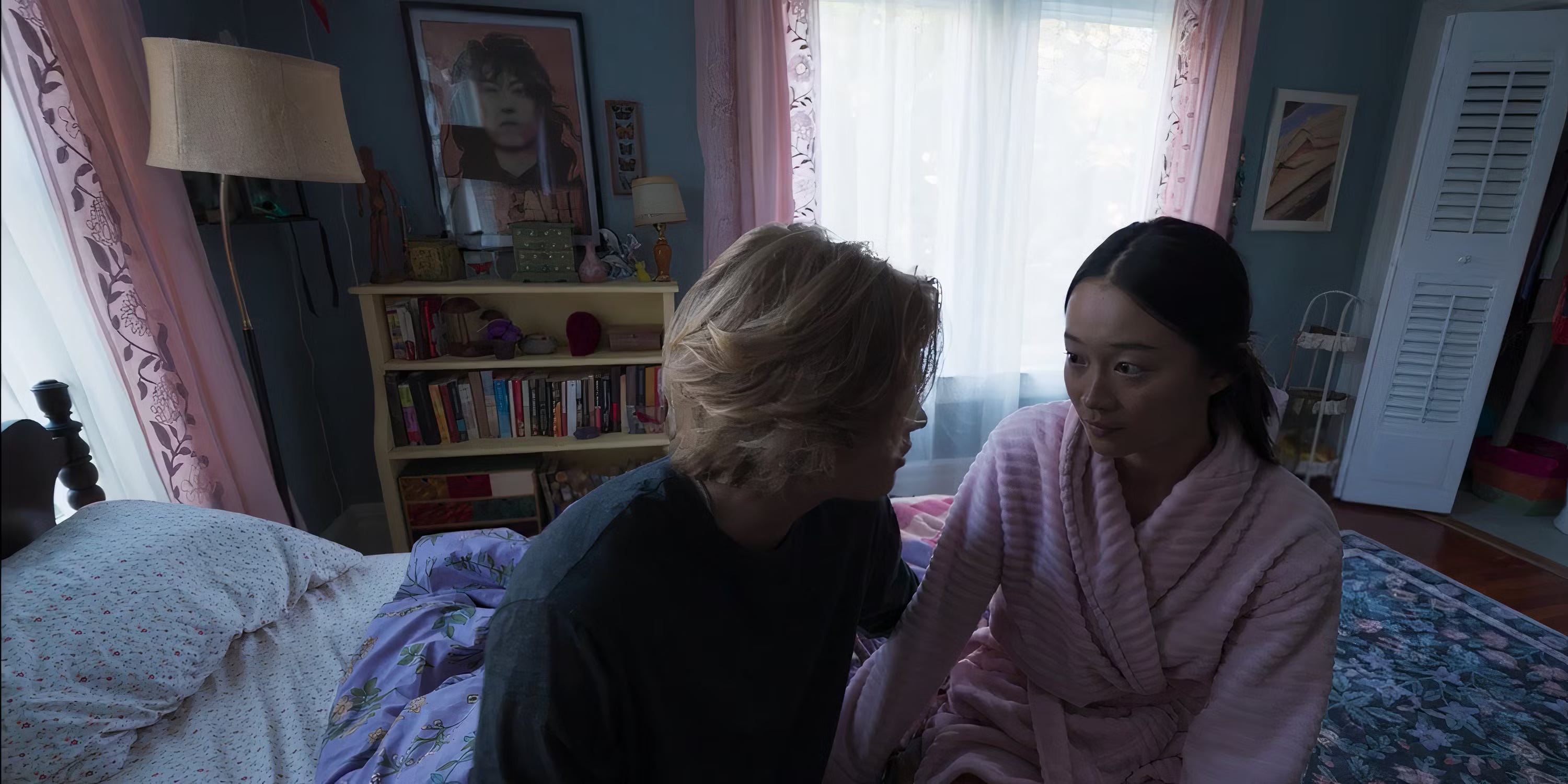
There was a poster of Leda and the Swan hanging up on Chloe’s bedroom wall, foreshadowing the rape. The film follows the structure of a Greek tragedy. The revelation at the end is a traumatic mirror that exposes the family’s ignorance of the perverse invader they welcomed in their home.
A fantasy takes shape: the fantasy of protecting women's virtue, the virtuous sacrifice and necessary death of the young man and his bright future to protect the young woman.
How does this align with ideology? Perhaps the film deals with a fantasy related to young women’s bodies, their vulnerability, desirability, and central role in structuring the nuclear family’s aims toward social reproduction.
All of society is the young woman’s voyeur. The young woman is the central anthropomorphic embodiment of capitalist demand (Tiqqun, 2012). The consumer and the consumed, the promise of the reproduction of the nuclear family, the prize. (See “Preliminary Materials for a Theory of the Young-Girl").
The film lays bare discomfort with young women's sexuality, their presumed vulnerability, and audience’s fantasies about the role of men in preserving virtue or despoiling it by rape. What the film exposes is that the nuclear family coheres by its attempt to preserve and engage in young women’s sexuality.
Good films help us see and challenge what fantasies we enjoy and what ideological forces keep them in place.
In the case of Presence, I believe that it challenges the fantasy of the happy nuclear family by exposing that the nuclear family is sustained by the preservation of young women’s sexual virtue, the sacrifice of young boy’s bodies toward parent’s narcissistic aims, and the unconscious working of eroticism, sexual jealousy, and impotence/castration in family dynamics.
Grief in the Nuclear Family
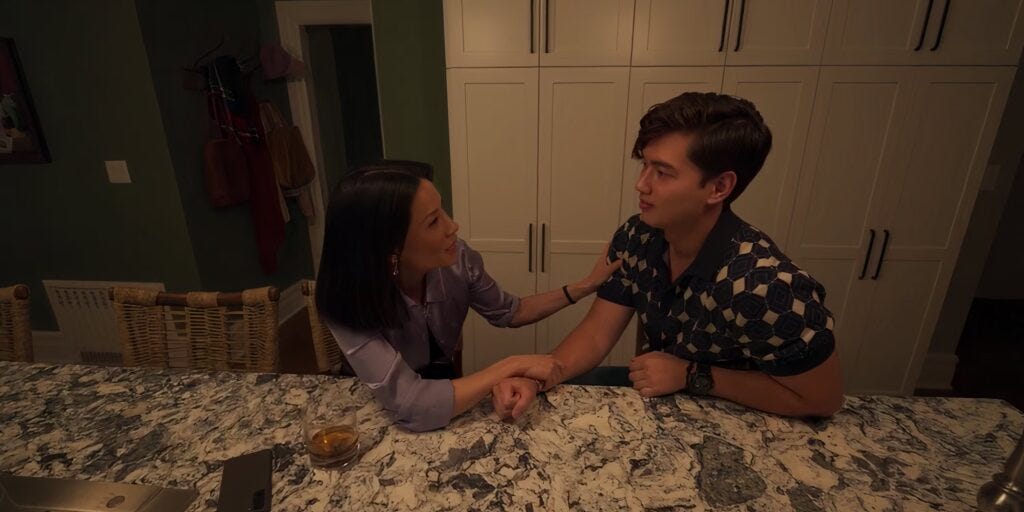
Grief, loss, pain, sexuality, and jealousy are central to the dynamic of the nuclear family. This film starts off with an intact family and leads to a traumatic rupture: the realization that the dead son was present all along. The dead son has been exposed as having existed in tandem with the living son. The film ends in pain and release of pain. The son had already been dead from the start.
The son’s death was integral in preserving the relations between the other family member’s. The instability/fragility/violence/sexual jealousy of the nuclear family is at its very core. Death itself is the presence, exerting its subtle influence, making us uneasy with its gaze. The traumatic mirror at the end of the film reveals death itself. The audience assumes the p.o.v. of Death, who stalks the family with a foreign and invasive desire.
Works Referenced
McGowan, T. (2007). The real gaze: Film theory after Lacan. State University of New York Press.
Metz, C. (1982). The imaginary signifier: Psychoanalysis and the cinema (C. Britton, A. Williams, B. Brewster, & A. Guzzetti, Trans.). Indiana University Press. (Original work published 1977)
Tiqqun. (2012). Preliminary materials for a theory of the young-girl. Semiotext(e).